Be yourself; Everyone else is already taken.
— Oscar Wilde.
This is the first post on my new blog. I’m just getting this new blog going, so stay tuned for more. Subscribe below to get notified when I post new updates.
Be yourself; Everyone else is already taken.
— Oscar Wilde.
This is the first post on my new blog. I’m just getting this new blog going, so stay tuned for more. Subscribe below to get notified when I post new updates.
One of the main ways I will try to preventing bullying in my classroom is by educating students on what bullying is. I was once talking to one of my peers who said that she was bullied most of her years in grade school but she did not realize it until she looks back on it now. This is sad to think about because she said that she did not know what bullying was and was not aware that she was being mistreated. I want to prevent this from happening to other students.
Another way I want to prevent bullying is by having my students take charge in helping to prevent it. I want their helping in setting expectations for how to correctly treat each other. They will also help find resources to share with those who are being bullied and programs for preventing bullying from occurring. I will task them with designing posters and pamphlets in my advisory classroom that can be displayed both in my classroom and in the entire school.
Finally, I would like to prevent bullying in my classroom by demonstrating to students the harmful effects that bullying can have on others. I want students to examine case studies and watch videos to see the damages that the various forms of bullying can have on others. I believe that this will really hit home with the students because it will give them a real life example the negative effects of bullying, which they can better relate to.
During class a few weeks ago, one of my fellow pre-service teachers discussed the benefits of using icebreakers in the classroom. She talked about how she would use icebreakers in her elementary class, and it made me want to research icebreakers that would be effective in a middle school setting. Below are three icebreakers that I would like to use in my middle school math classroom.
In this icebreaker, students either line up or get in small groups (blobs) according to a certain prompt. I have seen this done both with and without talking. This is a great activity to use because it allows students to quickly see what they have in common with their peers without creating too much anxiety. Some example prompts are:
In this icebreaker, students must pick a side between two options. They then must discuss with the group they are in that picked the same side as them and share out to the class as group why they picked this side. This game encourages students to work on both small group and whole class discussions while also getting to know something about each other. Some sample prompts are:
I really like the idea of creating a giant Jenga with random questions on every block because it creates a very relaxed, interactive atmosphere in the classroom. Most students already know how to play Jenga, which should relieve some of the anxiety, and it will make students feel nostalgic if they used to play it when they were little. It will also create many laughs, which is the best form of breaking the ice.
Growth mindset is a fairly new concept that is sweeping the education world. It is the idea that our brains are capable of changing and growing, and that we need to believe is this in order for growth to occur. Fixed mindset, on the other hand, is the idea that we are “born with what we have.” People with fixed mindsets believe they are not capable of learning or succeeding in a certain task or skill. Instilling students with a growth mindset is important in every subject, but it needs to become a necessity in math.
Students will often enter middle and high school math having an idea about whether they are a “math person” or not. This thinking is detrimental to the success of the student in learning and achievement. Students who think they are good at math will become easily discouraged when they are faced with math that is far beyond their current ability. They are afraid of messing up and so they do not try something new or more difficult. Students who think they are not a math person, will not feel like they can do or learn any new math. They become discouraged and frustrated easily during math class, which can also lead to classroom management problems.
When instilling a growth mindset in your math students, it is important to teach them that when they make a mistake, their brains grow. Students are often afraid of making mistakes in a math class, and so teachers must create an environment where students feel comfortable trying new things and failing or making mistakes. One way to do this is to pick a favorite mistake and share out why you liked the mistake and what can be learned from it. Another way is to have class “math talk” in which students are sharing out their thoughts and critiquing each other’s thinking. This allows students to learn from each other without being afraid of being wrong.
Building relationships is one of the most important parts of classroom management. Students will not feel safe or be able to effectively learn if they do not have a positive relationship with their teacher. Listed below are a few ways that I will build relationships in my classroom.
When establishing rules and setting expectations, they should be given in a positive yet clear manner. It is also important that you have high expectations for each of your students. Students know when a teacher believes in them and when they are being pushed to succeed. Students need this push because it is what drives them to learn. I will do this by making sure my students all know they I believe in them and their abilities through private conferencing, individual help, and praise. I will also do this by helping them set goals and providing them with the resources and help to reach their goals.
In a middle school, it is sometimes hard to develop a sense of classroom pride because students are in your classroom for a short period of time. One way I will build the pride is by displaying student work. I believe that you are never told old to love having your work shown off. Whenever we do a project based problem or do some activity, I will display the work around the room and allow time for students to present their projects. I will also take the time to allow students to talk about accomplishments they may have outside of class, which will also serve as team building.
Middle school is a time when students start to really experience stress, and this comes from a variety of places including academics, social life, athletics, home-life, etc. I want my classroom to be an area wear students can relieve some of their stress. At the beginning and throughout the year, I would like to incorporate stress relief strategies and coping strategies. Playing soft music in the background during independent work time, and creating a cozy classroom is another goal I have. It is also important to make sure that I am managing my own stress because a stressed teacher is very harmful to student-teacher relationships. I will have to make sure to have personal time when I am away from the classroom, and to monitor my stress levels while I am at school.
It is important to be aware of what students in your class have experienced trauma. For students who have experienced trauma, it can sometimes be more difficult for them to learn because they may not be having their basic needs met, or they may be searching for a feeling of love and safety. It is the schools job to try and provide this sense of safety and structure to students while they are at school so that they can learn.
Truama informed is difficult for me because I have not had a traumatic childhood and a majority of my classmates in grade school did not either. Even when I went to high school, very few students experienced trauma, but I could tell how the ones who had did differently in school. Having such little experience with it personally, I am worried about how I will be able to recognize it and help my students, especially the ones who are more reserved about it.
At my current clinical placement, I have a class of lower level students. When talking to them and the teacher I have discovered that many of them have experienced trauma in their lives. When trying to help them with their math, I first make sure that I introduce myself to them and use positive words. They already do not think they are capable of math and often times do not ask questions, so I make a point to thank them for trying and asking me questions. A majority of the students now come up to me and ask me questions before they will ask the teacher. I hope that forming this relationship with them will help them form relationships with other math teachers and make them more open to learning.
When discussing differentiation in the classroom, people usually discuss four areas that can be differentiated 1) content, 2) process, 3) product, and 4) learning environment.
When differentiating content, it does not mean that you are changing what you teach, rather it means you are changing the difficulty of what you teach. Some students are farther ahead and get bored by what other students still need to learn or master. For these higher-level students, you can give tasks or activities that address some of the higher levels of Bloom’s Taxonomy, such as analyzing, evaluating, and creating. For the students who are at a lower-level, you can give them activities that are on the lower end of Bloom’s Taxonomy, such as remembering and understanding. In my future math classroom, if we are learning about converting fractions to decimals, I might have the students who are struggling with the concept practice long division in general and then move on to converting decimals using long division. For the students who aren’t struggling but haven’t yet mastered the skill, I would have them converting fractions in a real-life context, such as a word problem. For the students who have mastered it, I would challenge them to make their own problems or scenarios in which they need to convert fractions to decimals, or I might even give them a project to work on.
When differentiating the process, it is important to know the different learning styles and to know how your students learn best. When I teach the lesson on converting fractions to decimals, there are a few ways that I can differentiate the process. One way is by showing a video or playing a song describing the steps. Another way is by allowing students to work with manipulatives or draw pictures when justifying their answer. I could also have a class discussion regarding the relevancy of the topic.
The product is how the student proves they have mastered the content. When thinking about the product, it is important to allow students to have a variety of options to pick from. At the end of the fraction and decimal unit, I could give students the following options to prove mastery:
Mission and vision statements are an important part of a school because they state the goal of the school (vision) and how this goal will be achieved (mission). Below are the mission and vision goals that I would make for my school.
At Reagan Middle School, we believe in growing the total student. Throughout their years here, students will learn valuable skills that will help them succeed as students and productive citizens.
Reagan Middle School’s mission is to set high expectations for every student and to help them achieve their goals. Teachers will collaborate across the curriculum to ensure that learning is cohesive and engaging for all students. Students will take part in exploratory classes and diverse lessons to gain a wider knowledge and appreciation of the world. Advisory classes will foster a sense of team within the school community.
A large part of the middle school concept involves teaching the total student, which means addressing the emotional, physical, mental, and academic parts of the student. One way to address all of these parts is to teach life skills, which can also be referred to as social skills. The typical time to teach these skills in the middle school is during Advisory class.
Many life skills are important for students to learn, but there are a few that are ideal for teaching to middle school students.
“Learning to learn” is a life skill that students will use throughout their lives. There are a few explicit strategies that students can be taught to use, such as close reading, annotated notes, etc. that will help them acquire this skill.
“Problem Solving” is a skill that I can teach both during math class and in advisory. I will teach this by allowing students to attempt solving problems independently or in groups before I give them hints or the method to use to solve it. Project-based learning is also an excellent opportunity to teach this skill.
“Critical Thinking” can be cultivated in students by challenging them during class time and by using project-based learning. I can also teach this by asking students questions that will prompt them to think more critically and have deeper discussions.
“Service Learning” is a great opportunity for the whole class or school to get involved in the community and reflect on what they are doing. Many middle schools try to do at least one service learning project a year.
“Goal Setting” will be valuable to utilize in any class because studies have shown that setting goals raises student academic achievement. I will also teach students how to set goals for life and how to track their progress towards these goals.
“Teamwork” is an important life skill to teach to middle schoolers because it is such a large part of the middle school concept and will help them in future years. Teamwork is especially built during Advisory class.
“Leadership” can be taught by providing students with ample opportunities to get involved in clubs and to allow them to take on jobs within the classroom.
Class-Wide Function-related Intervention Teams (CW-FIT) is a classroom management program that helps to address problem behaviors that main function are to get teacher attention, peer attention, or escape. When students do not respond to the main CW-FIT program, there are also targeted strategies that can be used, such as help cards.
Students must be explicitly taught the expected behaviors. This teaching is typically done through direct instruction, and should include:
The expectation should be taught and practiced over a series of days, typically 3-5. This repetition and engagement with the expectation allows for the students to better learn and understand it.
In a CW-FIT classroom, students are divided into teams. These teams usually consist of 3-6 students, and are typically divided according to rows or groups of desks, depending on how the room is set up. At the beginning of the day, a daily goal is set for how many points each team should get. Teams are awarded points by the teacher whenever every member of a team is exhibiting appropriate behavior after a certain amount of time. For example, in my classroom I could set a goal for teams to get 10 points by the end of class. Every 3 minutes, I would check the teams to see which ones have every member displaying the expected behaviors. Each team that is displaying the expected behaviors would get a point. At the end of the class hour I would look at the total points and whichever team got the total points would receive a reward. This reward can include things such as stickers, 5 minutes of a class game, free time, etc. In my classroom, I would typically use the reward of 5 minutes of free time at the end of the day or 5 minutes of a class game.
I like CW-FIT in the middle school setting for many reasons. The middle school structure by nature is very team-oriented with students being divided into teams within their grade level. This means that students would already be familiar with the team concept and be comfortable with the format. CW-FIT is also a great intervention in my opinion because for it to work, the expectations must be explicitly taught and rehearsed. I believe that this is important because teachers often assume that students know what they expect of them when it comes to behaving correctly. With CW-FIT, I will know for sure that students know my expectations because they are extensively taught and practiced. Finally, CW-FIT is a very positivity oriented intervention program. Teachers are supposed to give praise to the teams that are following expectations and simply not acknowledge the teams who are not. This means that positive attention is the only attention being given, which is important for building a positive, safe classroom.
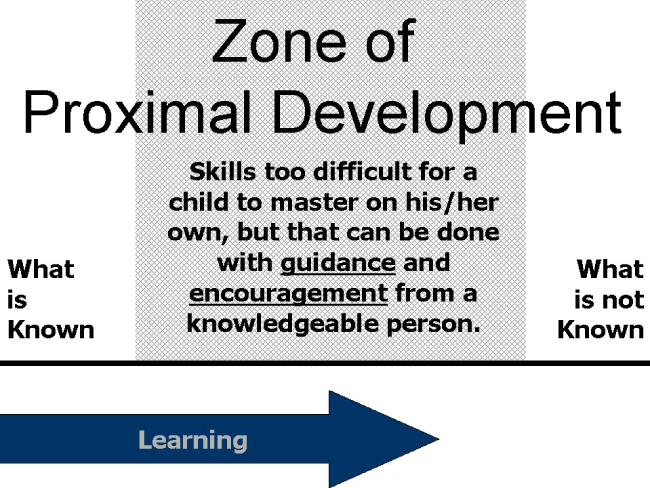
Lev Vygotsky was known for his theories in cognitive development. One of his most well-known theories was the zone of proximal development (ZPD). When talking about ZPD, it is important to remember that scaffolding is a huge part of it. Below is a diagram showing what the zone of proximal development looks like. The ZPD diagram is composed of three layers or levels. The first level is what a student can learn on their own. The second is what a student can learn with help. Frustration level is the level in which the material is beyond the students reach.
When students are in the first level, or the level in which they can learn on their own, they will become bored. This is the level in which they know what they are doing and are not challenged. When they become bored, behavior issues start to arise. They are no longer engaged in their school work and the activity, and they start to goof off. In math class, this happens when students are forced to just memorize multiplication facts or some other low level of work. Most students also tend to get bored whenever they are forced to relearn or review something from the previous year that they are already proficient at.
When students are at the “beyond my reach” level, they are not able to learn the new information even with help. They become frustrated with the work, and they become discouraged. This also leads to students acting out because they do not want to do the work or attempt the work. They tend to become even more frustrated in this phase as the teacher keeps trying to push them. It is important for teachers to know what their students can do and where their frustration level is.
One of the best ways to make sure students are in the ZPD is by using formative assessments and pre-assessments. Before starting a unit, it is important to make sure a teacher knows where the students are at. In my future class, I will make sure that I give students a pre-assessment for the unit a few days before we start so that I can adjust my plans accordingly so that they are not bored or frustrated.

 Miss Wieberg