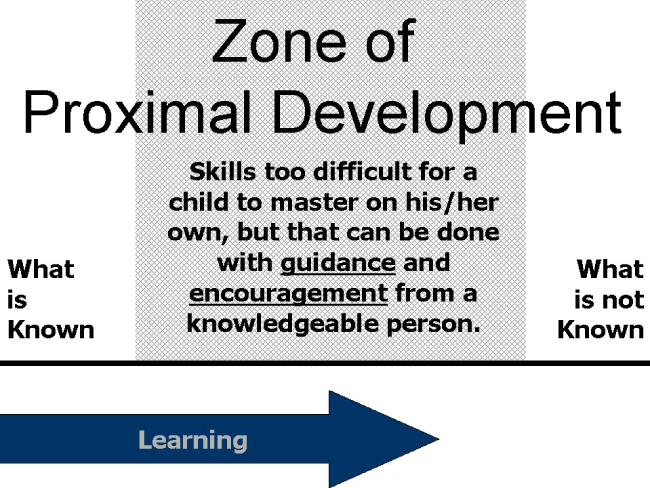
Lev Vygotsky was known for his theories in cognitive development. One of his most well-known theories was the zone of proximal development (ZPD). When talking about ZPD, it is important to remember that scaffolding is a huge part of it. Below is a diagram showing what the zone of proximal development looks like. The ZPD diagram is composed of three layers or levels. The first level is what a student can learn on their own. The second is what a student can learn with help. Frustration level is the level in which the material is beyond the students reach.
When students are in the first level, or the level in which they can learn on their own, they will become bored. This is the level in which they know what they are doing and are not challenged. When they become bored, behavior issues start to arise. They are no longer engaged in their school work and the activity, and they start to goof off. In math class, this happens when students are forced to just memorize multiplication facts or some other low level of work. Most students also tend to get bored whenever they are forced to relearn or review something from the previous year that they are already proficient at.
When students are at the “beyond my reach” level, they are not able to learn the new information even with help. They become frustrated with the work, and they become discouraged. This also leads to students acting out because they do not want to do the work or attempt the work. They tend to become even more frustrated in this phase as the teacher keeps trying to push them. It is important for teachers to know what their students can do and where their frustration level is.
One of the best ways to make sure students are in the ZPD is by using formative assessments and pre-assessments. Before starting a unit, it is important to make sure a teacher knows where the students are at. In my future class, I will make sure that I give students a pre-assessment for the unit a few days before we start so that I can adjust my plans accordingly so that they are not bored or frustrated.
 Miss Wieberg